
Ayahuma: The Sacred Amazon Tree That Named Our Retreat
It was a November evening in 2025. Thomas and Tanya were walking through the jungle with Maestro Elvis, our head shaman, learning the names and stories of the medicinal plants that grow along the paths between the trees. The light was going. The forest was becoming something different, the way it does at dusk, more itself, somehow.
And then they came to her.
The Ayahuma tree. A massive, ancient presence growing beside the path, her trunk draped in clusters of large, round, rust-brown fruits, dozens of them, hanging at eye level like a gathering of silent faces. Tanya stopped first, drawn in by a scent she hadn't expected, something deep and sweet and floral. Thomas stopped. Maestro Elvis stopped. None of them quite knew why, or perhaps all of them did.
Tanya was already in love. Without knowing the tree's history or its name in any language, she recognised something in it , the stature, the fragrance, the weight of it?
Thomas looked up at the fruits. And without thinking, without planning to say anything meaningful at all, he said: "Ayahuma is a great name for a healing centre."
Maestro Elvis and Tanya agreed before the sentence had finished.
That same evening, they took a plant bath prepared with the Ayahuma fruit — a Shipibo tradition of cleansing and intention — before their last ayahuasca ceremony. Less than a week later, Ayahuma Retreat Centre was born.
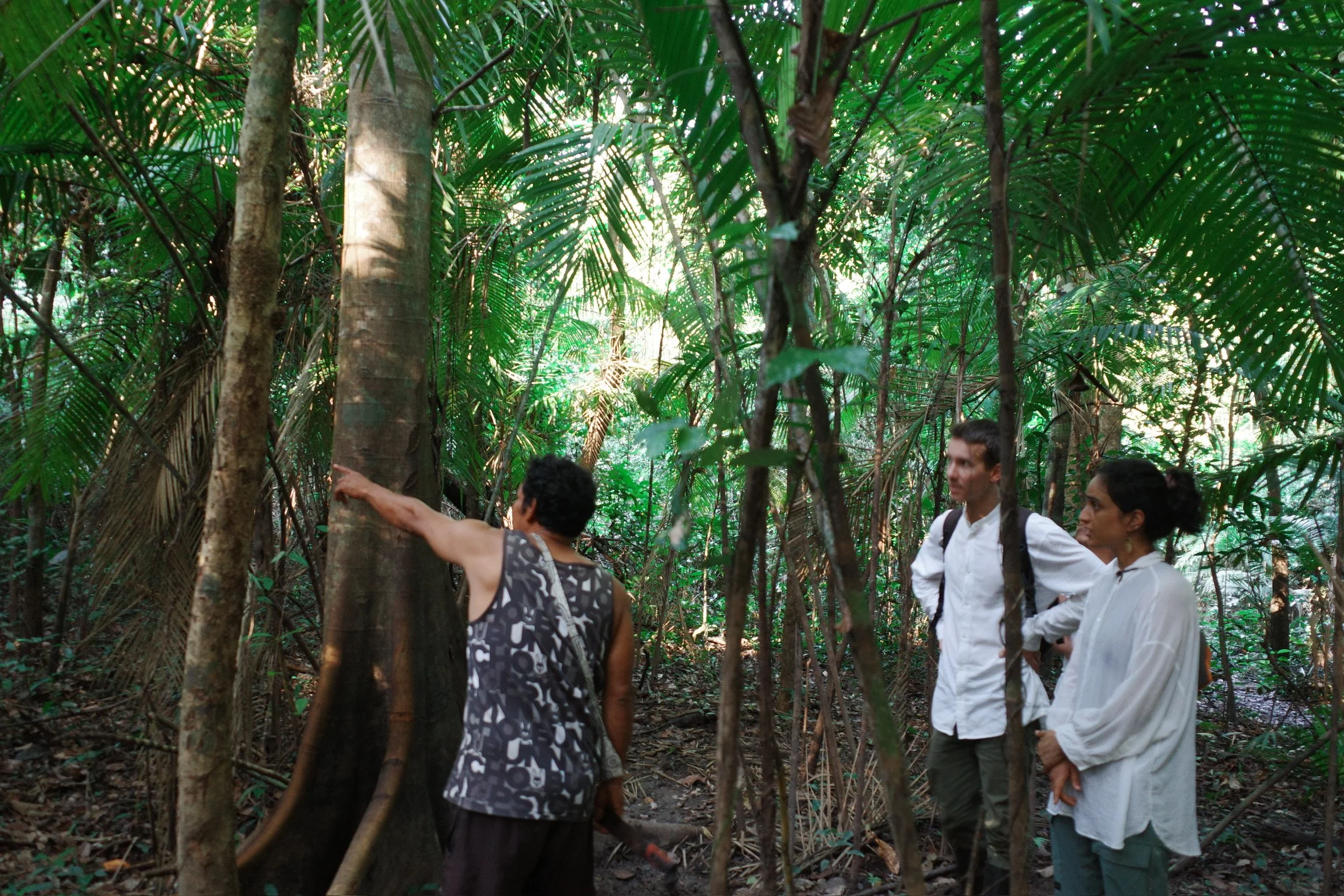
That walk in November 2025
What Is the Ayahuma Tree?
Botanists know it as Couroupita guianensis, a member of the Lecythidaceae family, the same family as the Brazil nut, native to the tropical rainforests of north-eastern South America. In India, where it has been cultivated for centuries around Shiva temples, it is known as the nagalinga tree, or Kailash Pati. In English it has acquired the practical name "cannonball tree," for the most obvious of reasons: its fruits, which hang in dense clusters directly from the trunk and main branches, are large, brown, woody spheres, roughly the size and weight of a cannonball, swaying gently in the forest air.
But in the Amazon, in the region where we are, the tree has always been called something else.
Ayahuma. In the Quechua traditions of the upper Amazon, the word translates as "heads of spirits," or sometimes "spirit heads." Look at a trunk of a mature tree in full fruit, and you will understand immediately. Dozens of round, rust-brown spheres, clustered together in the shadows of the trunk, staring back at you like the faces of something ancient and watching. Not frightening. Something older than frightening.
A Tree That Lives Between Worlds
Everything about the ayahuma tree seems to belong to two worlds at once. The practical and the sacred. The visible and the invisible.
Her flowers are among the most extraordinary produced by any tree on earth, erupting directly from the bare trunk and woody branches in long racemes of deep orange, scarlet, and pink, with a complex hooded structure and a fragrance that intensifies through the night and into the early morning. Each individual flower lives for only ten to twelve hours. It opens, and by the following morning it has fallen petals across the earth. And yet the tree flowers almost continuously, so there are always new blooms opening as the old ones return to the soil. Death and renewal, cycling without pause.
The fruits she produces take an entire year to mature. A single tree may carry fifty to one hundred and fifty of them simultaneously, at every stage of ripeness. When a fruit finally falls and opens, the pale inner pulp transforms in contact with the air, slowly changing colour from white to blue as it oxidises. A fruit that contains its own slow alchemy.
The tree is pollinated almost entirely by large carpenter bees, drawn to her by scent and colour. She offers no nectar, only pollen, and the bees come anyway.
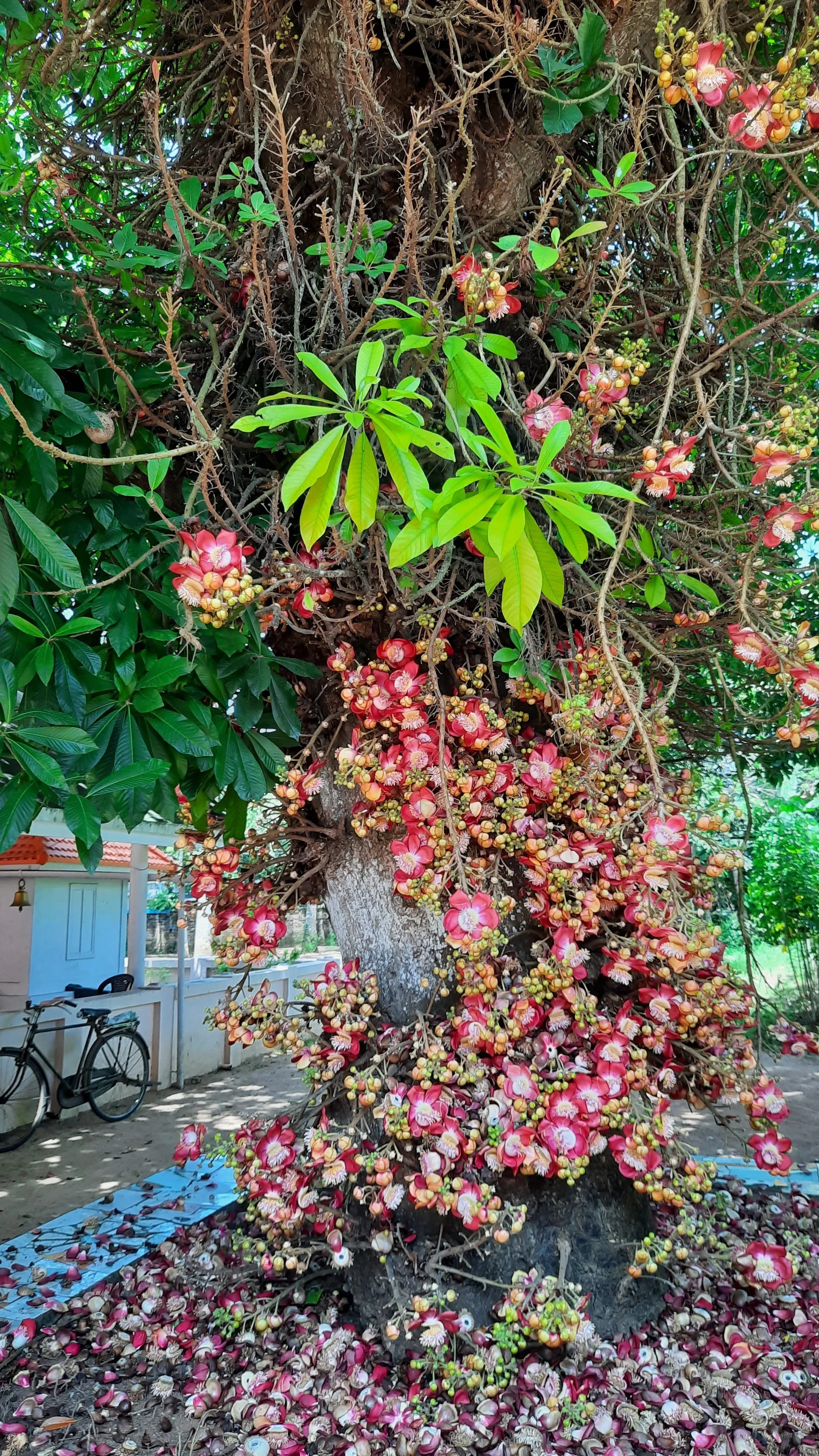
By Fotokannan - Own work, CC BY-SA 4.0.
Sacred Across Continents
Months after that evening in the jungle, Tanya, who has been a devotee of Lord Shiva for years, made a discovery that stopped her in her tracks.
The Ayahuma tree, this same Couroupita guianensis that had drawn the three of them to a halt on a jungle path in Peru, is one of the most sacred trees in Hinduism. It has been planted in the grounds of Shiva temples across the Indian subcontinent for centuries. Its flowers are offered to Shiva at dawn. The reason is impossible to miss once you have seen the flower up close: the hooded structure of petals — white and pink arching over the stamens at the centre — resembles, with startling precision, the great naga serpent protecting the Shivalingam, the sacred axis. In India it is called Nagalinga, or Nagamalli, or Kailash Pati. It is the flower of the cosmic guardian.
For Tanya, to discover that the tree she had fallen in love with in the Peruvian Amazon was also a tree that had been sacred to her own tradition for millennia, was, in her words, mind-blowing.
It is remarkable that peop on opposite sides of the earth, with no historical contact, would independently recognise this tree as worthy of reverence. What does that tell us? Perhaps that some plants carry a quality that transcends cultural categories. That the forest has its own way of making itself known to those who are paying attention.
A Plant That Heals
The Shipibo-Conibo people of the upper Amazon have always known the Ayahuma tree as part of the living pharmacopoeia of the forest. Traditional uses across South America include the fruit pulp applied to cleanse wounds, the young leaves used to ease toothache, and preparations from the leaves, roots, and bark used by shamans in the treatment of malaria. The flower fragrance — rich in eugenol, linalool, geraniol, and dozens of other aromatic compounds, has been used in traditional formulations for inflammatory conditions and skin ailments.
Modern pharmacological research, while still in early stages, has confirmed that Couroupita guianensis contains a striking diversity of bioactive compounds across every part of the plant: alkaloids, flavonoids, terpenoids, phenolic acids, and essential oils, with demonstrated antimicrobial, anti-inflammatory, antioxidant, and anticancer activity in laboratory settings.
None of this surprised Maestro Elvis. For a healer who has spent more than thirty years learning from the forest, bioactive compounds are simply the language scientists use for something he has known since his apprenticeship, this tree carries medicine. Not only in her chemistry, but in her presence.
The Teacher of Those Who Teach
For Maestro Elvis, and for the Shipibo tradition he carries, the forest is not a backdrop to the healing work. It is the source of it. Every plant, every being, every energy in this ecosystem is a teacher and a healer learns over a lifetime to listen to all of them.
The Ayahuma tree is not a medicine taken in ceremony. She is something older than that, a presence in the forest that the great healers and plant teachers have always sought out, recognised, and learned from. In Maestro Elvis's understanding, she is the teacher of those teachers.
She was growing here long before we arrived. She will be here long after us. We named our retreat after her not to claim her, but to acknowledge her, this forest, this tradition, this understanding that healing happens not only in ceremony but in every moment of genuine attention to what is alive around you.
Come and sit with the spirits
Ayahuma Retreat Centre opens in July 2026 in the Peruvian Amazon near Puerto Miguel. We welcome a maximum of eight guests at a time for our signature seven-night Ayahuma Journey, including ceremonies with Maestro Elvis, dieta preparation, integration support, and the kind of unhurried care that only comes from a place that understands itself as family.
Explore our retreats → Reach out to us →
Sources & Further Reading
Chandana Y., Suchitra M., Chandra Y.P. (2025). "A potential review on Couroupita guianensis Aubl: A sacred botanical treasure of India, known for its numerous medicinal uses." Journal of Pharmacognosy and Phytochemistry, 14(5): 563–570.
Joshi M.A., Wattamwar S.S. et al. (2024). "The Cannonball Tree: A Tree of Beauty and Mystery." International Research Journal of Biological Sciences, 13(1): 29–34.
Kavana G.B., Pavithra S., Vidya S.P. (2021). "Couroupitaguianensis (Nagalinga Pushpa): a sacred plant of India." Readers Shelf, Vol. 17, Issue 6.
Lawrence A.S., Venkatraman A. (2020). "An updated review on Couroupita guianensis Aubl: a sacred plant of India with myriad medicinal properties." Journal of Herbmed Pharmacology, 9(1): 1–11.
